15 Hidden Financial Red Flags That Should Stop Your Deal in Its Tracks
The Cost of Missing Hidden Financial Red Flags
Buying a business is one of the biggest decisions you’ll make. When the numbers look “good enough,” it’s tempting to move quickly and trust what you see. That’s where buyers get hurt.
Serious problems rarely sit in plain sight on the income statement. They hide in the timing of revenue, the quality of receivables, inventory practices, tax compliance, and the management of working capital. On the surface, everything looks fine. Underneath, you could be taking on risks that will drain your cash and stall your growth.
According to the Association of Certified Fraud Examiners, financial statement fraud accounts for a small share of cases, but the median loss is roughly three-quarters of a million dollars. Even if the probability feels low, the potential damage is huge.
A disciplined due diligence audit goes beyond a quick P&L review. It asks tougher questions, follows the cash, and tests whether performance is truly sustainable once you own the business.
How to Use These 15 Red Flags in Your Due Diligence Checklist
Think of this list as an upgrade to your due diligence checklist for buying a business. It doesn’t replace legal or tax review; it sharpens the financial lens.
As you work through your business acquisition due diligence, use these red flags to decide when to:
Pause and ask better questions
Renegotiate price and terms
Walk away completely
Stop, Question, and Then Decide
One red flag is a signal to slow down. Several clustered around revenue, cash flow, and working capital are a sign to step back and reconsider the deal itself, not just the valuation.
10 Deal‑Stopping Financial Red Flags You Can’t Ignore
These are the issues that should make you hit pause immediately. They don’t always mean “never,” but they do mean “not until we understand this clearly.”
1. When Revenue Looks Great—but It’s Pulled Forward
If revenue spikes at quarter‑end, shipments go out after period‑end, or “bill‑and‑hold” sales are common, you may be seeing tomorrow’s revenue booked today.
What to Ask and Do Next
Compare sales trends to cash collection; AR shouldn’t grow faster than revenue.
Ask for sales by month, shipping logs, and credit memos.
Consider bringing in a financial due diligence auditor to test the revenue cutoff.
2. One Customer Holds Your Future Cash Flow
If one customer accounts for 30–40% (or more) of revenue, especially on a short‑term contract, your entire deal depends on that relationship. Analysts who study acquisitions regularly note that heavy customer concentration increases earnings volatility and raises the risk that performance will drop right after closing.
What to Ask and Do Next
Review revenue by customer for the last 2–3 years.
Request top‑customer contracts in your due diligence documents.
If you proceed, consider price adjustments, earn‑outs, or performance‑based payments tied to the customer's continued engagement.
3. EBITDA Is Rising, but Cash Flow Isn’t
Profit on paper with weak or negative operating cash flow is a major warning sign. You may be seeing aggressive revenue, poor collections, or inventory that isn’t moving. Quality‑of‑earnings work in M&A due diligence often starts here, because persistent gaps between earnings and operating cash flow are among the clearest signs that results may not be sustainable.
What to Ask and Do Next
Compare EBITDA and operating cash flow over several years.
Analyze trends in AR and inventory days.
Use this insight to adjust valuation and the working capital target in your M&A due diligence process.
4. “One‑Time” Expenses That Never Go Away
Occasional non‑recurring costs are normal. But if “one‑time” legal, consulting, or restructuring costs show up every year, they are part of the real cost structure.
What to Ask and Do Next
Ask for a schedule of all add‑backs with supporting invoices.
Look across multiple years for repeating “non‑recurring” items.
Rebuild EBITDA without questionable add‑backs and negotiate from that number.
5. Liabilities You Don’t See on the Balance Sheet
Vague accruals, growing warranty claims, quiet tax disputes, or matters mentioned but not explained can all mask future cash hits. In many disputes after a sale, buyers point to under‑accrued tax, legal, or warranty obligations as the issues that should have been identified and treated as debt‑like items before closing.
What to Ask and Do Next
Request legal and tax correspondence for recent years.
Review warranty policies and claim history.
Treat clear exposures as debt‑like items that reduce the purchase price and consider escrows or specific indemnities.
6. Working Capital Quietly Propping Up the Numbers
Stretching payables, letting inventory pile up, or letting AR age can make short‑term profit and cash look better than they really are. Major law firms that work on merger and acquisition accounting frequently flag working capital adjustments as a common source of tension between buyers and sellers after closing.
What to Ask and Do Next
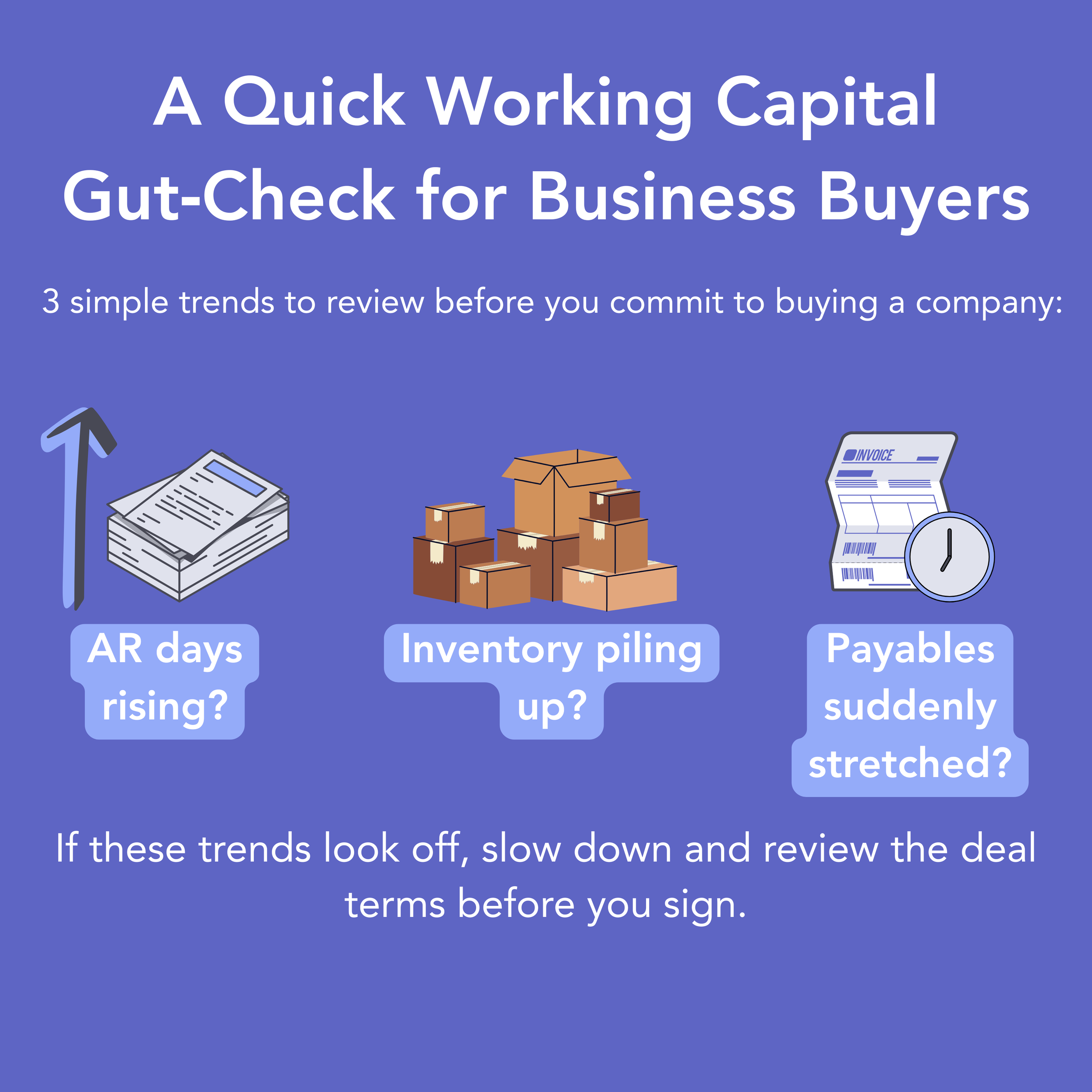
Compare AR, inventory, and AP days over time; watch for sudden shifts.
Review AR aging and inventory aging schedules.
Bake realistic working capital needs into your merger acquisition checklist and deal terms.
7. Inventory That’s Really a Future Write‑Off
Old, obsolete, or unsellable inventory carried at full cost inflates gross margin and EBITDA.
What to Ask and Do Next
Request inventory by item/SKU with last‑movement dates.
Ask about obsolescence reserves and write‑offs.
Factor write‑downs into your model and price.
8. Related‑Party Deals Distorting the Picture
Below‑market rent, above‑market salaries, owner‑funded loans, or family‑run vendors can make earnings look better or worse than they’ll be under your ownership.
What to Ask and Do Next
Identify leases, loans, and services involving owners or relatives.
Recast results at market rates.
Decide which relationships must continue and what new agreements you’ll need at closing.
9. “Tax Savings” That Are Really Deferred Bills
Unpaid payroll taxes, aggressive sales tax positions, or ignored multi‑state obligations often show up later as painful surprises.
What to Ask and Do Next
Request tax returns, notices, and payment plans.
Ask specifically about payroll and sales tax compliance.
Treat clear underpayments as debt‑like and negotiate price and protections accordingly.

10. Books and Controls You Can’t Trust
Missing reconciliations, large unexplained adjustments, and poor documentation make it impossible to know what you’re really buying. When financial records are unreliable, it doesn’t just affect valuation—it often forces buyers to expand the scope of due diligence audits or walk away entirely, because there is no solid baseline to underwrite the deal.
What to Ask and Do Next
Ask how often bank and key accounts are reconciled and by whom.
Request reconciliation schedules and support for major entries.
If you can’t gain confidence in the numbers, even with help from a due diligence auditor, be ready to walk away.
5 Red Flags You Can Sometimes Live With—If You Handle Them Right
These issues don’t always kill a deal, but they do demand a sharper pencil on price and a clear plan.
11. Margin Compression with a Credible Story
If falling margins are tied to explainable events (short‑term pricing, temporary cost spikes) and there’s a realistic plan to recover, you may proceed with a discount and clear expectations.
12. Underinvestment and Deferred Maintenance
Old equipment or outdated systems often mean you’ll need to spend more post‑close. Quantify the catch‑up, build it into your model, and reflect it in your offer.
13. Vendor Concentration and Fragile Supply Chains
Relying heavily on a single supplier increases risk, but it can be mitigated with alternative sources, stronger contracts, or contingency plans identified during your merger and acquisition due diligence.
14. Unusual Payment Terms and Channel Practices
Extended terms or heavy discounting may be normal in some industries. In others, they signal pressure. Decide whether you’re willing to unwind risky practices after closing.
15. Policy Changes and Capitalized Expenses
Accounting clean‑up ahead of a sale can be fine, or a way to smooth earnings. Understand what changed, rebuild comparable periods, and make sure your valuation is based on consistent policies.
From Red Flags to Better Deals: What to Do Next

Red flags are not meant to deter you from pursuing acquisitions. They are meant to give you clarity.
Some issues mean “stop now.” Others mean “slow down, adjust price, and add protections.” Many can be managed if you identify them early and build them into your due diligence list for business acquisitions and your negotiation strategy.
Why You Don’t Have to Do This Alone
Most owners don’t live in financial statements every day. A specialized due diligence auditor with M&A experience can help you:
Turn raw financials into a clear, decision‑ready due diligence report
Test revenue, cash flow, and working capital quality
Identify where to push on terms—and when to walk away
Build Your Own Due Diligence Checklist for Buying a Business
As you plan your next deal:
Turn these 15 red flags into a short, personalized checklist.
Interested in what an M&A Due Diligence Checklist looks like? Read my blog about them here.
Decide which are absolute deal breakers for you.
Learn more about Due Diligence Audits here.
Involve your financial team early, before you are emotionally committed.
The goal is simple: buy strong, sustainable businesses and avoid inheriting problems you never agreed to take on.