Why Even Great Controllers Need a Second Set of Eyes
You close on time. Your reconciliations are buttoned up. The board packet goes out when it should, and when someone wants “the real story” behind the numbers, they come to you.
And yet, as lending standards tighten and board questions get sharper, it’s hard to ignore a thought in the back of your mind:
“If someone really dug into this, would everything hold up the way I think it would?”
If that sounds familiar, you’re not alone. Many strong controllers and CFOs at privately held, mid‑sized businesses are discovering that solid internal processes are necessary but no longer sufficient, as banks, boards, and potential investors increasingly expect independent validation, often in the form of a financial statement review or audit.
Scrutiny is rising, even when performance is solid

Over the last few years, banks have steadily raised the bar on commercial lending. The Federal Reserve’s Senior Loan Officer Opinion Survey (SLOOS) shows that banks have tightened commercial and industrial lending standards and toughened terms such as collateral requirements, covenants, and pricing for riskier borrowers, and that this trend has persisted over multiple years.
For finance leaders, that often translates into:
New requirements for reviewed financial statements or audited financial statements
More detailed questions about estimates, reserves, and controls
Tighter scrutiny of covenant calculations and supporting documentation
You may feel proud of your team and your processes, while also feeling the weight of being the last line of defense if something is missed. That tension is exactly where an independent financial statement review or audit from a trusted San Diego CPA can help.
Strong internal processes don’t eliminate blind spots
If you’re consistently closing on time and there are no recurring fires, you’re doing a lot right.
But there’s a difference between
Running an effective internal close and reporting process, and
Presenting reviewed financial statements that can stand up to probing questions from lenders, boards, or potential investors who don’t live inside your systems every day.
As your business grows more complex (multiple entities, new revenue streams, changing contracts, evolving debt structures), the room for reasonable judgment calls grows as well. Those judgments may be sound, but if they live mostly in emails, spreadsheet tabs, and team conversations, they can be hard to explain and defend to someone outside the organization.
A second set of eyes from an experienced financial statement auditor doesn’t imply your work is inadequate. It provides structure, documentation, and independent validation around the work you’re already doing, so you’re not relying solely on personal credibility when scrutiny increases.
That’s the lens the HB team and I bring to every financial statement review and audit: protect what you’ve built and give you confidence under tougher questions.
What your bank actually sees in your numbers
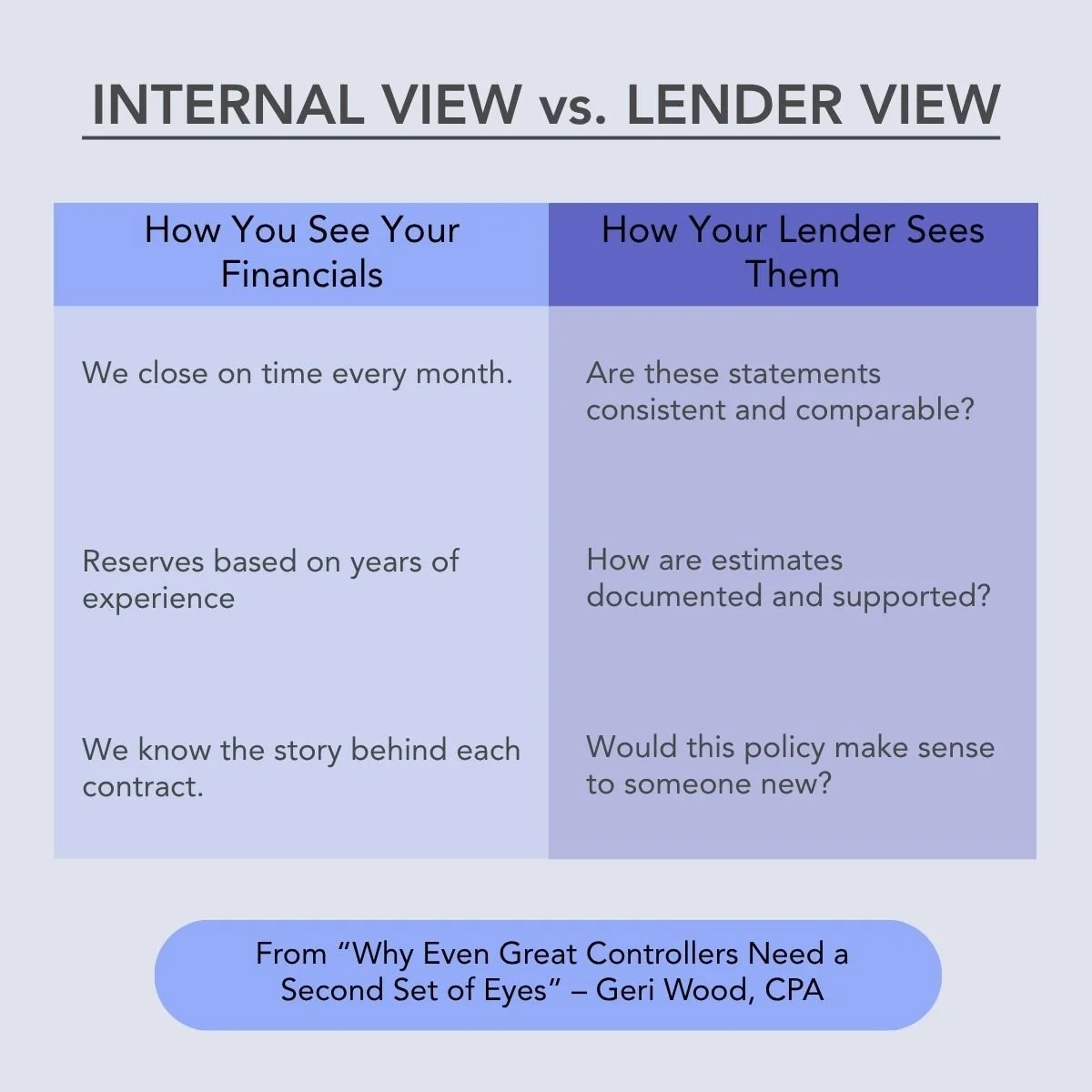
From the inside, financial statements are the output of a thousand daily decisions. From the outside, lenders and boards see something different.
They’re looking for:
Consistency over time
Clear, transparent disclosures
Evidence that estimates and controls have been challenged, not just documented
Research backs up what many finance leaders already suspect. In a survey of commercial bank lenders, more than 90% of respondents, most of whom primarily made credit decisions on loans between $250,000 and $50 million, reported that they explicitly evaluate and respond to differences in financial‑statement quality when structuring debt contracts.
In other words, higher‑quality, independently validated financials, whether through a financial statement review or audited financial statements for small businesses, don’t just “check a box.” They can influence:
How your bank prices the loan
How strict your covenants are
How much flexibility you have if performance dips temporarily
For many privately held companies, that’s the practical difference between financing that supports growth and financing that constrains it.
The worry: “Would this hold up if someone dug deeper?”
Even in well‑run finance functions, there are familiar areas of unease:
Estimates and reserves
Bad debt, inventory, warranty, and other reserves often rely on experience‑based judgments. You may have logic and historical data behind them, but is it documented in a way an independent reviewer would find persuasive?
Revenue recognition and cut-off
Complex contracts, milestones, or bundled services can make timing and allocation tricky. You may know the intent and history with each customer, but an external party sees only the contract and the accounting.
Inventory and costing
In changing environments (new product lines, supply chain shifts, and price volatility), cost assumptions can drift away from the original model.
Covenants and scenarios
Covenant calculations may be technically correct, but how well are your assumptions and stress tests documented if a lender asks for more detail?
The internal questions are usually the same:
“Is what we have now enough if someone truly independent asks us to prove it?”
“Will our reasoning make sense to someone who doesn’t know our quirks and history?”
That’s not a sign of weakness. It’s a natural consequence of being responsible and self‑aware in a more demanding environment, especially when lenders are used to reviewed financial statements.
Partnership, not punishment: how a good review or audit feels
Unfortunately, many controllers and CFOs have experienced auditing financial statements as something painful:
Last‑minute document requests
Vague explanations of “why” something is needed
A tone that feels more like judgment than support
A good review or audit relationship should feel very different. In practice, that looks like:
Working through you, not around you
The controller or CFO is the central partner. The goal is to validate and strengthen what you’ve built, not sidestep it.
Respecting your processes
Rather than imposing a one‑size‑fits‑all approach, a CPA takes the time to understand your systems, industry context, and constraints, and then builds on that foundation. I like to focus on making the process as seamless and beneficial as possible while still being meticulous.Clear communication and realistic timelines
You know what’s needed, why it’s needed, and when it’s needed. So you can plan around close calendars, board meetings, and staff capacity. The aim is to avoid surprises, not create more of them.
Right‑sizing the level of assurance
Financial statement reviews often offer the right balance when lenders or boards start asking for more without yet requiring a full audit. Audits come into play for higher‑stakes situations: major financing, potential sale, private equity involvement, or complex structures.
When done well, the process leaves you better prepared, not burned out, and gives you a partner you can reach out to as new questions arise throughout the year.
How a second set of eyes strengthens your position
For you as the finance leader, the upside is both professional and personal.
Professionally, independently reviewed financial statements or audits can help you:
Walk into bank and board meetings with fewer unknowns
Present numbers and narratives that are backed by a documented, third‑party process
Show owners and boards that you’re proactively managing risk, not waiting to react to it
Strategically, stronger financial reporting can keep doors open. A 2025 study in The Accounting Review found that private firms subject to public financial‑reporting requirements had a higher probability of obtaining private equity financing, with similar effects for venture capital and private‑company acquisitions.
The message is clear: higher‑quality, more transparent reporting doesn’t just help with today’s bank renewal. It can expand your options for whatever comes next.
Personally, the benefit is peace of mind: moving from hoping your documentation and judgments will be enough to knowing they’ve been pressure‑tested with you by a San Diego CPA who understands your business and is invested in your long‑term success.
How to raise this without undermining your team
If you’re considering a financial statement review or audit but don’t want to send the wrong signal internally, framing matters.
You might say to owners or boards:
“Our internal processes are strong. Given how bank and investor expectations are changing, this is about validating what we’re already doing and making sure it stands up to the next level of scrutiny.”
“A financial statement review doesn’t replace our work; it backs it up for lenders and potential buyers.”
That positions external assurance as what it should be: a logical next step in a tougher lending and capital environment, not a reaction to a problem.
A low‑friction next step with a San Diego CPA
If you’re feeling the pressure from lenders or boards and want to know whether a financial statement review or audit would meaningfully strengthen your position, the simplest next step is a short, focused conversation with a San Diego based CPA, such as myself or your already established Hutchinson and Bloodgood CPA.
Walk through:
Where scrutiny is increasing
What your current reporting and documentation look like
Whether reviewed financial statements or an audit are the correct, right‑sized moves for your situation
From there, you can decide whether a second set of eyes is the right level of protection and validation for you and your company, on your terms and on your timeline.