If you help run a 401(k) plan, you already juggle enrollment, payroll changes, and vendor calls. It’s easy to treat a 401(k) audit as something you’ll deal with “when we actually have one.” The same goes for 403(b) plans, where a 403(b) audit can feel far off, right up until it isn’t.
But most findings don’t start with the auditor. They start with small process gaps in HR, payroll, and vendor coordination.
Instead of a traffic‑light rating, use these five questions as a practical self‑check. For each one, the goal is to be able to say:
“Yes, and here’s how we handle that.”
If your honest answer is “no” or “I’m not sure,” you’ve just found a clear place to focus before your next review. Along the way, we’ll touch on what is needed for a 401(k) audit so you can see where your current processes line up, and where they don’t.
1. Can we clearly explain why we do—or don’t—need a 401(k) audit this year?
What this question is really about
This is your understanding of when a 401(k) audit is required. In simple terms, you need to know:
How many eligible participants you have at year‑end
How that count is determined (who’s in, who’s out)
Whether you fall into “large” or “small” plan status for Form 5500
If you can’t explain your current status without pulling up last year’s file or emailing your advisor, you’re relying on assumptions that might be out of date.
FAQs your HR team should be able to answer
When is a 401(k) audit required?
When does a 401(k) plan need an audit?
When do you need a 401(k) audit?
All three come down to the same core idea:
A 401(k) audit is needed for years when your plan meets the current “large plan” thresholds based on eligible participants at the beginning of the year, which is what pushes the plan into large‑plan Form 5500 filing status and brings in an independent audit. Those thresholds have changed over the 2023–2026 period, so it’s important to check the updated rules each year rather than relying on last year’s status.
Why it matters
Regulators and reviewers expect the plan sponsor to understand why a 401(k) audit is or isn’t required. If your participant count or interpretation of the rules is wrong, you might:
Skip an audit you should have had, or
Pay for an audit you didn’t need
Either outcome can raise questions about your filings and governance, and makes it harder to show that you understand what is needed.
If your answer is “no” or “I’m not sure,” try this:
Confirm the participant count logic. Ask your recordkeeper or CPA to walk you through how they arrive at the count used to determine when a 401(k) audit is required.
Document your conclusion. Keep a short note in your annual file: participant count, threshold used, and “audit required / not required this year” in simple language, with a link to your internal summary.
Review annually. Make this part of your year‑end checklist so it doesn’t get copied forward without fresh review, especially as the 2026 rules come into effect.
2. Do our HRIS, payroll, and recordkeeper tell the same story about each participant?
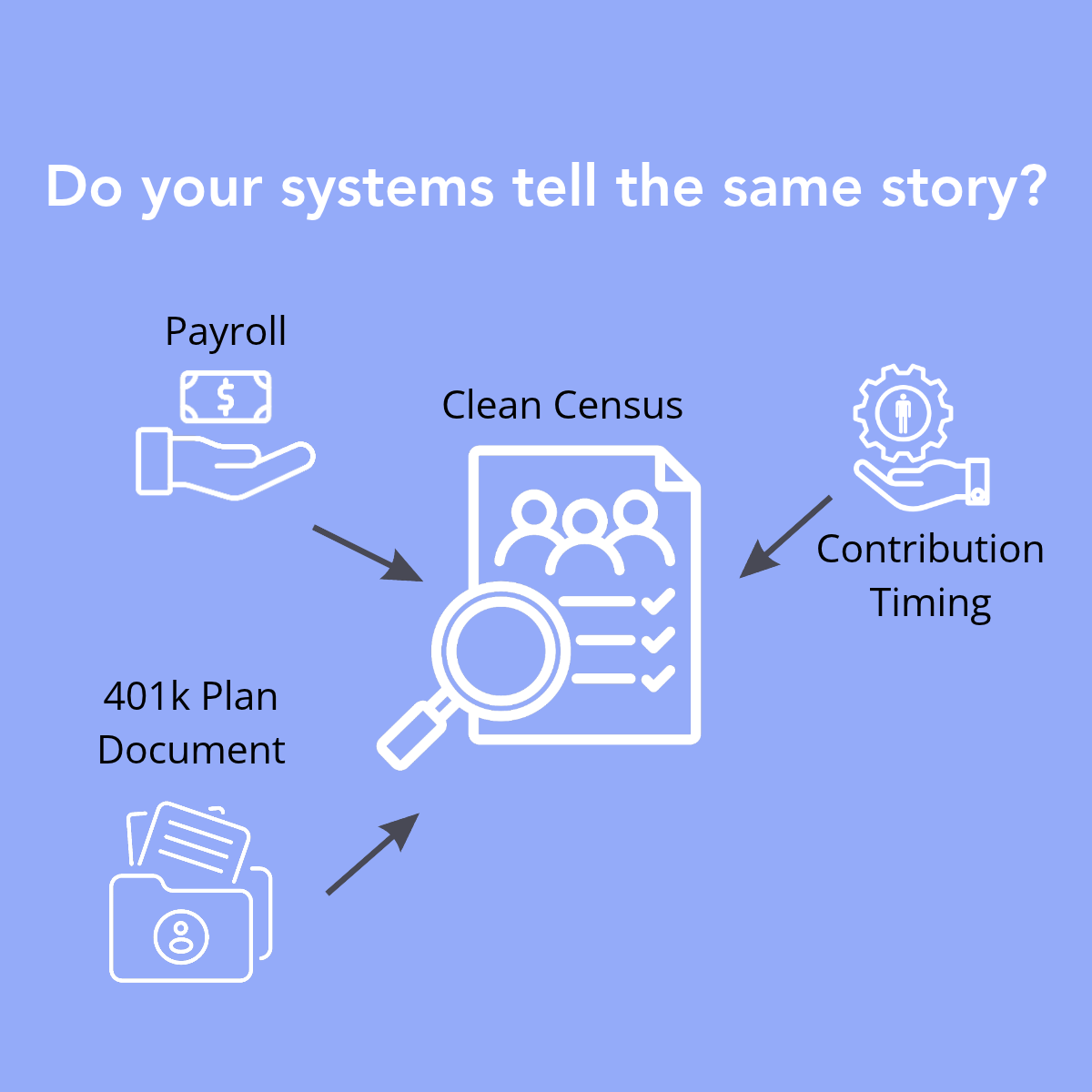
This is your census data. Key fields: hire date, termination date, date of birth, compensation, and status, should match across HRIS, payroll, and the recordkeeper.
If each system shows a slightly different version of the same person, it’s hard to prove your plan is operating according to the document.
Why it matters in audits of employee benefit plans
Clean census data is the foundation of almost every employee benefit plan audit test:
Who is eligible, and when
Whether contributions are calculated correctly
Whether service and vesting are accurate
When systems don’t match, audit services providers often see:
Missed or late enrollments
Incorrect deferral or match amounts
Wrong service credited for vesting
These issues can be fixable, but they’re stressful to untangle under audit timelines.
If your answer is “no” or “I’m not sure,” try this:
Pick a “source of truth.” Decide which system (often HRIS) is the official owner of key data fields. Document that decision.
Run a basic three‑way check. Pull a same‑date census from HRIS, payroll, and the recordkeeper. Spot‑check a sample of employees and log discrepancies.
Schedule regular mini‑reconciliations. Even a quarterly check can catch problems before your next ERISA audit.
3. Can we show how long it takes for deferrals and loan repayments to go from paycheck to plan?
What this question is really about
This is your contribution timing. For a typical pay period, you want to know:
Pay date
When payroll is finalized
When the file and funds are sent to the recordkeeper
When amounts post to participant accounts
You don’t just want to believe it’s “prompt.” You want to be able to show the actual pattern if anyone reviewing your 401(k) audit asks.
Why it matters
Contribution timing is a frequent focus area. If deferrals and loan repayments sit in the employer’s bank account for too long, that can create:
Compliance issues for late deposits
Lost earnings for participants that may need to be made up
Auditors often trace a sample of pay periods from payroll through contribution posting. Inconsistent or slow timelines are a common finding.
If your answer is “no” or “I’m not sure,” try this:
Map the real timeline. For a few recent pay periods, write down pay date, file‑sent date, and posting date. Look for the common pattern.
Set a clear standard. Based on what’s reasonable for your team and systems, define an internal target (for example, “within X business day(s) after payroll”).
Track and explain exceptions. Keep a simple log of each pay date and deposit date. Flag anything outside your standard and note the reason and fix.
4. Could we pull our 401(k) plan document and all amendments in under 10 minutes?
What this question is really about
This is about your 401(k) plan document and its amendments. The “10‑minute test” is a practical way to see if everything is organized:
Current signed 401(k) plan document
All signed amendments and restatements
Adoption and trust agreements, if applicable
If it takes three people and multiple email chains to find these, reviewers will immediately wonder what else is disorganized.
Why it matters
Every 401(k) audit starts by comparing your operations to your written plan terms. Auditors look at:
Eligibility rules
Contribution formulas
Compensation definitions
Loan and withdrawal provisions
If you can’t quickly produce a complete, signed set of documents:
Operations may not match the current 401(k) plan document
Old rules may still be in use
Required amendments might not have been fully implemented
That can lead to corrections and extra work with your auditor or advisor.
If your answer is “no” or “I’m not sure,” try this:
Create one secure “official” folder. Store all signed versions of the document and amendments in a central, labeled location.
Build a one‑page index. List each document, its effective date, signature date, and where it’s stored (with links or file paths).
Have someone test the 10‑minute rule. Ask a teammate who isn’t the primary plan contact to find each item using only your index.
5. If we changed vendors or plan design this year, did we capture what changed and when?
What this question is really about
This is about change management: recordkeeper changes, payroll system changes, or notable plan design updates such as match formulas, eligibility, or automatic enrollment.
Each change should have a short, clear story:
What changed
When it became effective
Which groups were impacted
How you communicated and updated processes
Why it matters
Auditors know that errors often show up around transitions. When they look at a 401(k) audit, they pay close attention to the period when:
Vendors were switching
New features rolled out
Processes or payroll codes changed
Without a clear record of “what changed and when,” it’s harder to:
Show that contributions and loans were handled correctly
Prove that old rules were turned off and new rules turned on at the right time
Explain any issues as one‑time transition problems rather than ongoing gaps
If your answer is “no” or “I’m not sure,” try this:
Create a simple change log for the year. One page listing each vendor or plan design change, the effective date, and the main impacts.
Collect key documents in one place. Agreements, conversion timelines, plan amendments, and example employee communications.
Note any cleanup completed. If you fixed missed contributions, loan issues, or coding errors after the change, keep a brief record of what was corrected.
Even if no 401(k) audit is on the calendar this year…
You might not meet the thresholds when a 401(k) audit is required right now. But working toward a confident “yes, and here’s how” for each of these questions will still help you:
Reduce compliance and operational risk
Protect employees’ retirement savings
Make future reviews, ERISA audits, or full 401(k) audits more predictable and less stressful
Use these questions as a repeatable self‑check each year. Over time, you’ll build a plan that aligns with what is needed for a 401(k) audit, keeps your plan document and data in order, and supports a smoother experience for your team and your participants as your organization grows.