If you use a Small Business Administration (SBA) 7(a) loan to buy a business at a purchase price of $3 million or more, an SBA quality of earnings (QoE) report is no longer optional. Under SBA Standard Operating Procedure (SOP) 50 10 8.1, effective October 1, 2026, an independent QoE is required for qualifying initial acquisitions and business expansions. Lenders must also underwrite your loan using the earnings supported by that report, not just the seller’s numbers (Misconish, R. 2026, SBA 7(a) Quality of Earnings: What the New $3M Rule Requires. PeaseBell).
In plain language: the QoE is now a gatekeeper for larger SBA deals. The decision you control is when you learn what your QoE will say. Buyers who do that work earlier, or ask sellers for a sell-side QoE, are far less likely to be surprised after the letter of intent (LOI).
What changed on October 1st for SBA quality of earnings report requirements and which deals it covers
Under SOP 50 10 8.1, an independent QoE report is required for SBA 7(a) Initial Acquisition and Business Expansion transactions with a business purchase price of $3 million or more. That threshold is based on total business purchase price, not the loan amount, and it excludes the appraised value of owner‑occupied commercial real estate.
A few details matter as you plan a deal:
The QoE is in addition to the required independent business valuation.
Owner Buyouts, employee stock ownership plans (ESOPs), and cooperative transactions are exempt from this specific QoE rule.
The QoE must be prepared by an independent, experienced financial professional engaged for the lender’s benefit, such as a CPA firm or transaction advisory firm with earnings‑diligence experience.
This is not just a buyer‑ or seller‑commissioned report handed to the bank. It is a separate engagement, performed for the lender, to verify historical earnings, test adjustments, and determine the earnings figure the lender can rely on. Those conclusions flow directly into the lender’s debt service coverage analysis, so the QoE can raise or lower the cash flow number that decides whether your structure works.
Why trailing earnings now matter more than projections
If you are used to thinking about “cash flow” mainly in terms of next year’s projections, this is a shift. Under SOP 50 10 8.1, SBA 7(a) initial acquisitions must demonstrate at least 1.25x debt service coverage, using historical or adjusted earnings based on the last fiscal year or the average of the last two fiscal years (Mohelsky, M. 2026. SBA Stopped Lending on Projections. SOP 50 10 8.1 Closes Acquisition Loans on Last Year's Numbers. MMCG). Buyers can no longer rely on projected post‑acquisition improvements to meet that coverage requirement.
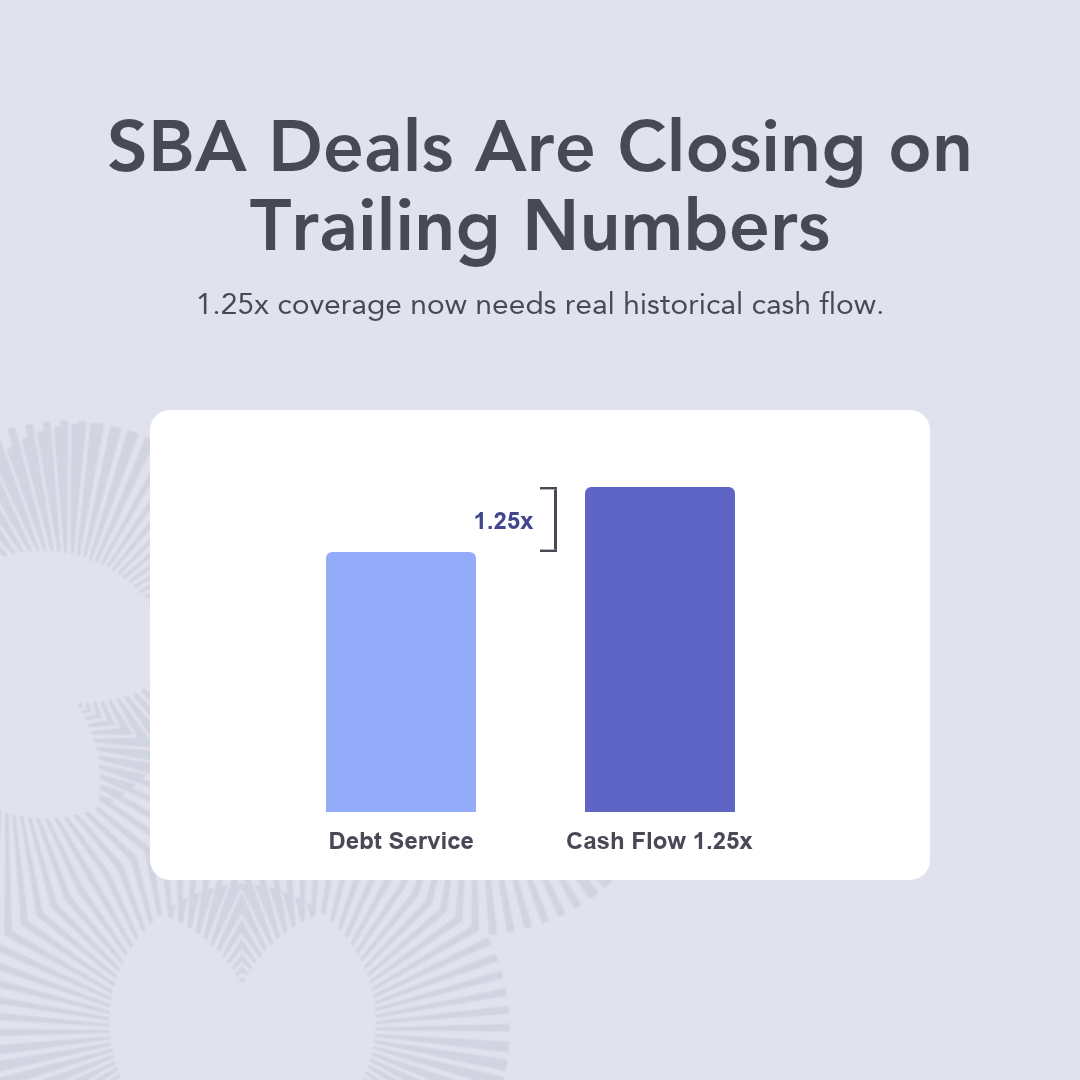
Lenders typically use the debt service coverage ratio (DSCR) to test this. DSCR compares cash flow available for debt service to total annual principal and interest payments. A 1.25x DSCR means the business generates roughly 25% more cash flow than is needed to cover its loan payments in a typical year
For example, assume:
Total annual SBA loan payments will be $400,000
The lender targets a 1.25x DSCR.
The lender is then looking for about $500,000 of reliable, recurring cash flow from the business. When you ask, “What does cash flow mean when buying a business?” for SBA purposes, that is the working answer. It is earnings, after realistic adjustments, that can reasonably be expected to continue and to service the debt.
The new pattern is described as SBA “closing acquisition loans on last year’s numbers,” meaning lenders look first to the most recent fiscal year or a two‑year average of historical earnings, not to post‑close projections (MMCG). Projections still help you explain your plan and test scenarios, but they no longer save a deal where historical cash flow, after realistic adjustments, does not reach the coverage floor. The QoE is the tool that turns those trailing results into the earnings number the lender will actually use.
What a lender‑focused QoE examines
A quality of earnings report is a structured analysis of how much of the seller’s reported earnings are real, recurring, and likely to continue after you buy the business. When the QoE is prepared for an SBA lender, it is aimed squarely at one question: Does this business generate enough supportable cash flow to repay the proposed loan?
Three areas matter most for you.
Revenue stability and concentration
The QoE examines how the business earns its revenue and how stable that revenue is.
You can expect analysis of:
Revenue trends over several years.
Customer concentration, including customers accounting for a majority of revenue
Contract terms and renewals where recurring revenue is involved.
Large projects, work in process (WIP), and deferred revenue that shift earnings between periods.
If revenue is concentrated in a few customers or tied up in highly cyclical work, that shows up as a risk. The lender may still proceed, but will weigh that risk against the DSCR and your structure.
Earnings adjustments and add‑backs
Most deals involve some version of “adjusted” or “normalized” earnings to reflect:
Market‑level owner compensation.
Removal of one‑time legal, consulting, or restructuring costs.
Elimination of non‑operating items.
A lender‑focused QoE tests each adjustment:
Is it documented and identified?
Is it truly non‑recurring or discretionary?
Would a typical buyer avoid this cost?
This is where deals can run into trouble. A confidential information memorandum might show a high “adjusted EBITDA” built on aggressive add‑backs. A conservative QoE may reduce or remove some of them, cutting the earnings used in the lender’s DSCR calculation and changing what the deal can support.
Working capital and cash needs after closing
The QoE also looks at working capital and cash demands.
You can expect attention to:
How quickly customers pay and whether receivables stretch.
Inventory levels and turns, if the business carries stock.
Vendor terms and seasonality.
If the business routinely ties up more cash than its earnings suggest, your effective coverage can be tighter than a simple income‑statement view shows. A deal that looks fine on paper can feel much thinner once you overlay real‑world cash timing.
How the rule changes your timeline and budget
For $3 million‑plus SBA‑financed deals, QoE is now a core step, not a nice‑to‑have. That changes when you need that report and how you plan your deal.
In smaller transactions, some buyers skip QoE entirely. Others wait until after the LOI or even after a lender term sheet to commission a limited review. If that late QoE reduces earnings or DSCR, you may have to renegotiate, bring more equity, or walk away after investing substantial time and advisory cost.
Under SOP 50 10 8.1, that late‑stage risk is higher, because the lender must use the earnings supported by the QoE in underwriting. If the QoE cuts cash flow below what the structure needs, the lender may not move forward.
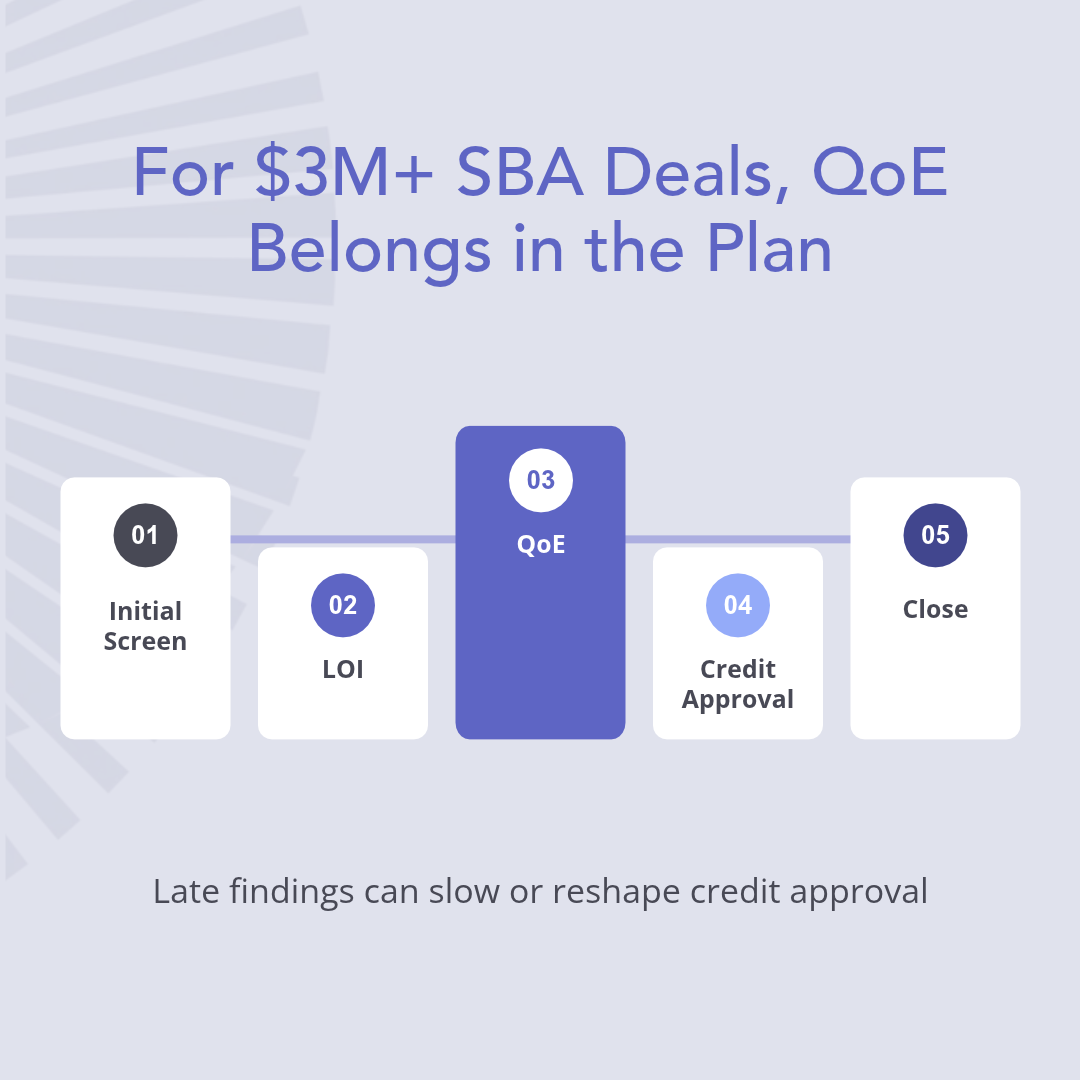
A more practical approach is to move QoE earlier:
Screen targets for coverage before LOI.
Use tax returns and financial statements to see if the business is likely to support a 1.25x DSCR after conservative, lender‑style adjustments.Plan QoE early in diligence.
Once you are under LOI, treat QoE as a central part of your due diligence when buying a small business, not as an optional extra.Coordinate with your lender.
Align the scope and timing of QoE with what the credit team needs, and leave time for questions.On the budget side, assume a QoE will be part of any SBA‑financed acquisition at or above $3 million. Treat it like legal review: a normal cost of doing a serious deal, not an exception.
What sellers of $3M+ businesses should do now
If you own or represent a business you hope to sell for $3 million or more, these rules affect your sale process even if you never read the SOP. A future buyer who wants SBA 7(a) financing will need a QoE that supports the earnings, and trailing results that clear the lender’s DSCR threshold.
You can improve your position by focusing on three areas.
Clean and consistent financials
First, tighten your financial records.
That includes:
Timely, accurate bookkeeping.
Clear separation of personal and business expenses.
Transparent treatment of related‑party transactions.
Internal financials that reconcile to tax returns.
Inconsistent or incomplete records often lead QoE providers to adjust earnings downward out of caution. That can make it harder for a buyer’s lender to support the price you are targeting.
Consider a sell‑side QoE
Second, consider a sell‑side QoE before you go to market.
A sell‑side QoE can:
Identify issues while there is still time to address them.
Help you understand how an SBA lender is likely to view your earnings.
Give buyers and their lenders a starting point for analysis, based on a structured, third‑party review.
It does not guarantee a specific outcome, but it can make the process more predictable and reduce the chance of major surprises after LOI.
Align add‑backs with lender expectations
Third, review your proposed add‑backs and adjusted earnings through a lender’s eyes.
Ask:
Is each adjustment clearly documented?
Is it truly one‑time or discretionary?
Would a typical buyer avoid this cost without harming the business?
Aggressive add‑backs that are not well supported are likely to be challenged or removed in a lender‑focused QoE. Being realistic and well documented from the start tends to produce a smoother process.
For San Diego buyers and brokers
San Diego buyers using SBA lenders, and the brokers who refer them, are already feeling this shift.
For example: a Mission Valley distributor with a $3+ million purchase price structure renewed their line of credit and then pursued an SBA‑backed acquisition. The lender relied on a QoE built on trailing local customer revenue and inventory swings, not just a growth story in new channels. That kind of scrutiny is now standard for larger SBA transactions in the region.
If you work on San Diego‑area deals, it is worth assuming QoE will be required once purchase prices cross the $3 million mark, and planning your process around that expectation.
What to do next
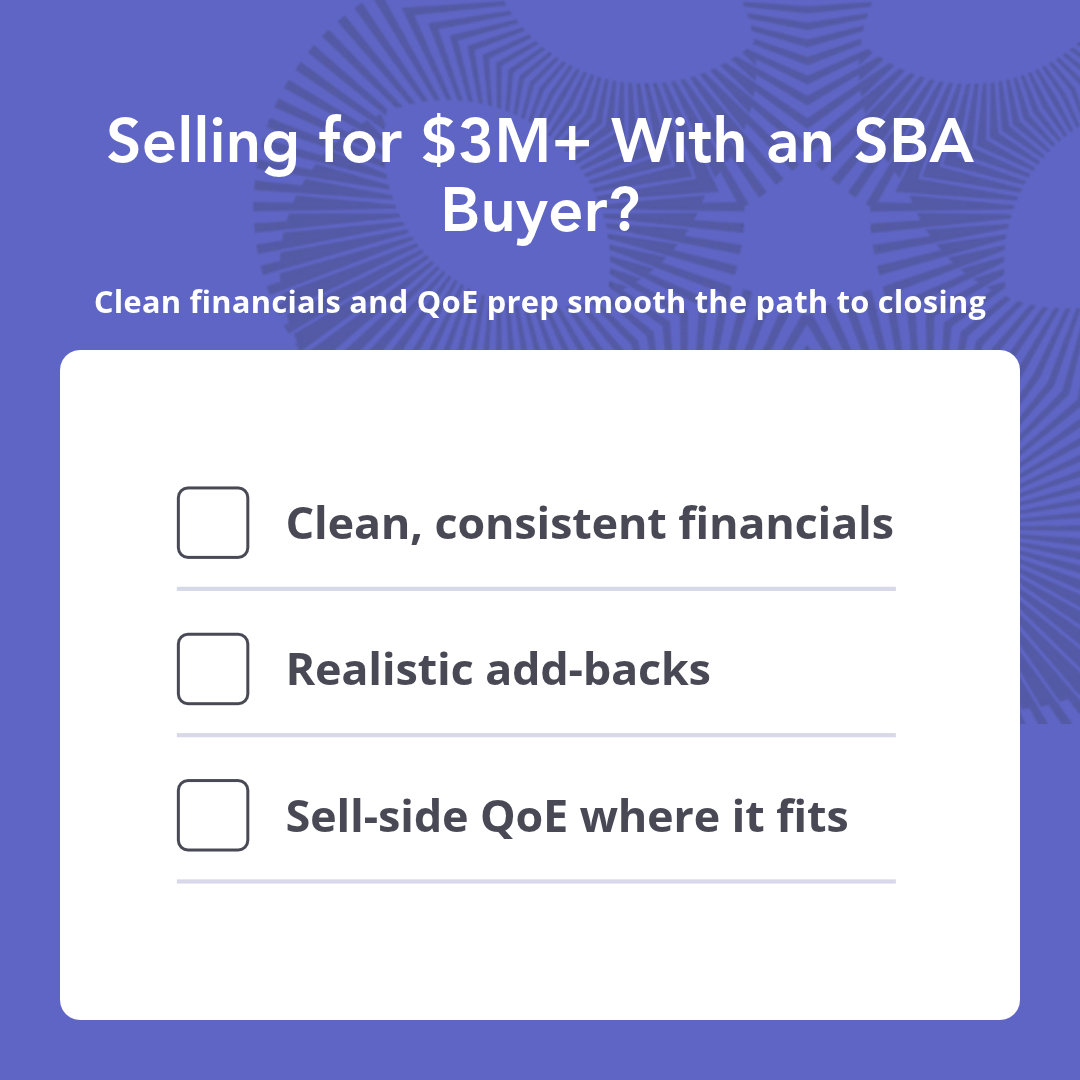
If you are planning to buy or sell a business at or above a $3 million purchase price with SBA 7(a) financing in view, here are practical next steps.
If you are a buyer, start with the trailing numbers.
Before you sign an LOI, evaluate whether the business is likely to support a 1.25x DSCR after conservative adjustments.Plan and budget for QoE early.
Treat QoE as a core part of due diligence and coordinate the scope with your SBA lender.If you are a seller, invest in clean records and consider a sell‑side QoE.
Clean financials and a well‑prepared QoE can make your business easier to finance and reduce surprises.Work with advisors who understand SBA and QoE.
Choose advisors familiar with SBA 7(a), DSCR, and lender‑focused QoE so expectations stay grounded in how deals are actually underwritten.Build realistic timelines.
Allow time for QoE, lender review, and follow‑up questions when you map out your closing schedule.
For San Diego buyers, owners, and contractors who are considering a $3 million‑plus acquisition with SBA financing and want an experienced view on earnings quality, schedule a consultation and review your options. Meet with Geri at our Mission Valley office or by video.